The Hidden Cost of Subscription Creep (And How to Stop It)
How "just $5/month" turns into $200/month without you noticing, and the psychology behind why we all fall for it.
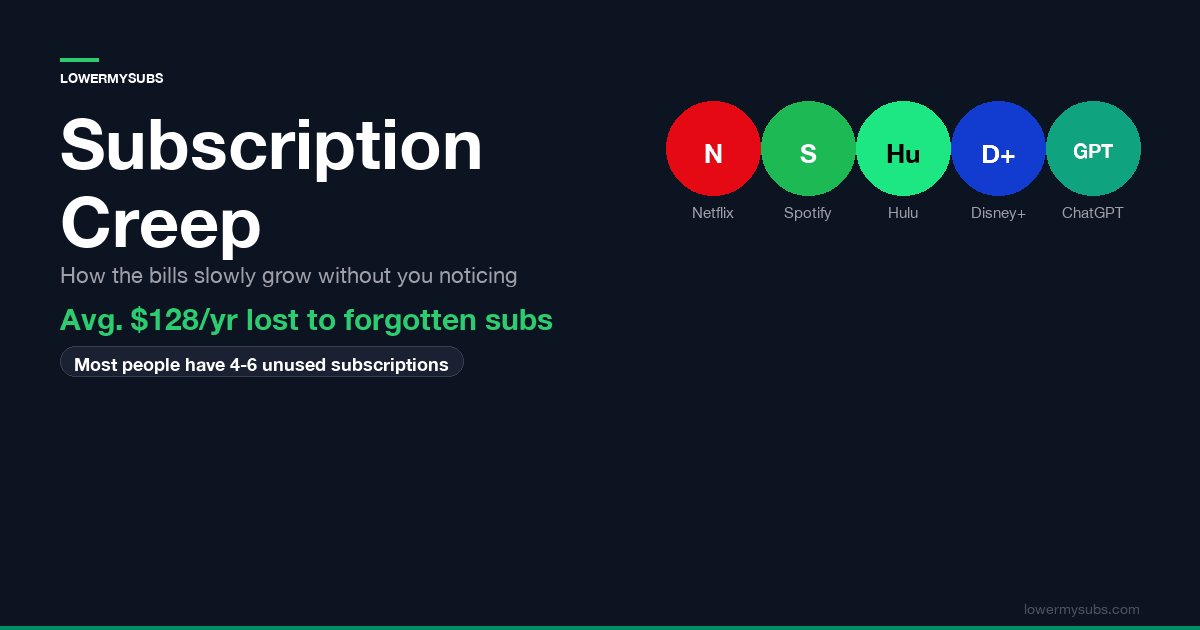
The $5 Trap
Subscription creep starts with a single $5 charge that seems too small to worry about. But that mental dismissal repeats with every new subscription, and within 18 months the average consumer accumulates 12+ recurring charges totaling $200+ per month, all individually justified, collectively wasteful.
Every subscription starts with the same pitch: "It's just a few dollars a month. Less than a coffee. Surely you can afford that?"
And you can. Of course you can. The problem isn't any single subscription. It's the 15th one. And the 20th. Each one passed the "it's just a few dollars" test individually, but nobody ever asked you to evaluate them as a total.
This is subscription creep, the gradual accumulation of small recurring charges that compound into a significant monthly expense without triggering your financial alarm bells.
Get weekly savings tips
Price-increase alerts and how-to-lower guides for the services you actually pay for. Free.
No spam. Unsubscribe in one click.
The Five Phases of Subscription Creep
Subscription creep follows a predictable pattern: discovery (free trial), commitment ($5 feels harmless), normalization (charge becomes invisible), accumulation (more services pile on), and realization (monthly total shocks you). Understanding these phases helps you interrupt the cycle before reaching the accumulation stage.
Subscription creep follows a predictable pattern. You might recognize yourself in one or more of these phases:
Phase 1: The Essentials ($30-50/month)
Every subscription journey begins with 3-4 genuinely essential services that cost $30-50/month combined, streaming to replace cable, music, and maybe cloud storage. You start with the services you genuinely need. A streaming service to replace cable. A music app because radio feels ancient. Maybe cloud storage because your phone keeps saying it's full.
This feels reasonable. Everyone has these. You're spending $30-40/month and getting clear value. You're not being irresponsible, you're participating in modern life.
Phase 2: The Upgrades ($50-80/month)
The second phase hits when free tiers stop feeling adequate, you upgrade to premium versions of tools you already use, adding $20-30/month in costs that each feel tiny in isolation. You move from free tiers to paid ones. The free version of that note-taking app is fine, but the premium version has that one feature you want. The free tier of your meditation app limits you to 10 minutes per session, but premium is unlimited.
Each upgrade is rational in isolation. $5 here, $10 there. You'll "definitely use it enough to justify the cost." And maybe you do, at first.
Phase 3: The Experiments ($80-120/month)
Phase three is where spending accelerates, you start trying new categories entirely, signing up for fitness apps, language learning, meal kits, and productivity tools that each promise to improve your life. You start trying new services. A fitness app because you're motivated to get in shape. A language-learning tool because you've always wanted to learn Spanish. A premium news subscription because you want to be better informed.
Many of these start as free trials. You sign up intending to cancel before the trial ends. But life gets busy, you forget, and suddenly you're being charged. And since you're paying for it anyway, you might as well give it another month to see if you use it...
Phase 4: The Duplicates ($120-180/month)
By phase four, you're paying for overlapping services without realizing it, two music apps, two cloud storage plans, three streaming services you rotate between but never cancel. Now you have overlaps. Two music services (one came with your phone plan, but you already had Spotify). Two cloud storage providers (Google One and iCloud+). Three streaming services even though you only watch one regularly.
You also have different services that do similar things: Notion and Evernote. Google Calendar and Fantastical. WhatsApp and Telegram Premium.
Each made sense when you signed up. But you never consolidated.
Phase 5: The Forgetting ($180-250+/month)
The final phase is invisible: subscriptions you signed up for months ago quietly renew while delivering zero value, pushing your total past $200/month without you noticing. Some subscriptions fall off your mental radar entirely. You signed up six months ago, used them for two weeks, then moved on with your life. But they're still quietly charging your card every month.
You're not deliberately paying for them. You've just... forgotten they exist. Until you see the charge on your credit card statement, think "what is that?", look it up, realize you haven't used it in months, and think "I should cancel that." But then you forget to actually cancel it.
By the time you reach Phase 5, you're often spending 2-3x what you'd guess if someone asked you.
Why Our Brains Are Terrible at This
Human brains evolved to evaluate one-time purchases, not recurring charges. Behavioral economists call this the "drip pricing" effect, small automatic payments bypass our loss aversion instincts because each transaction is individually painless. We literally lack the cognitive wiring to naturally track cumulative subscription costs.
Subscription creep isn't a personal failing. It's a predictable result of how subscription pricing exploits several well-documented cognitive biases:
The Anchoring Effect
Your brain uses the wrong reference point for subscription pricing, $9.99/month feels cheap compared to a $120 one-time purchase, even though the subscription costs more over a year. $9.99/month sounds cheap compared to a $120 annual fee, even though $9.99 × 12 = $119.88. Companies deliberately use monthly pricing to make the cost feel smaller.
When you see "$9.99/mo" your brain anchors to that single-digit number, not the $120/year you're actually committing to.
Status Quo Bias
Canceling a subscription feels like losing something you already have, which your brain weighs roughly twice as heavily as gaining something new, so you keep paying to avoid the loss. Once you're subscribed, cancelling feels like losing something, even if you're not using it. Behavioral economics calls this loss aversion: the pain of losing something feels about twice as strong as the pleasure of gaining something of equal value.
Cancelling your unused meditation app feels like "giving up" on becoming someone who meditates, even though you haven't opened it in four months.
Mental Accounting
Your brain treats each $9.99 charge as a separate trivial expense rather than adding them together, so 15 subscriptions at $10 each never triggers the alarm that a single $150 purchase would. Your brain doesn't naturally aggregate small recurring charges into a single "subscription budget." Each charge lives in its own mental bucket.
Netflix is "entertainment." Spotify is "music." The meditation app is "self-improvement." Your brain evaluates each one against its category, not against your total discretionary spending.
This is why people can simultaneously think "I'm careful with money" and also spend $250/month on subscriptions they barely use.
The Reduced Pain of Paying
Automatic payments bypass your brain's pain-of-paying circuit entirely, the charge happens invisibly, so you never experience the psychological friction that would make you reconsider. A one-time $200 purchase hurts. You feel it. You think about it. You might agonize over whether it's worth it.
But $16.67/month for 12 months? Barely noticeable, even though it's the same $200. Subscriptions distribute the pain across many small moments, none of which individually cross your "this is expensive" threshold.
The Optimism Bias
You sign up for subscriptions based on who you want to be, not who you are, the fitness app, the language course, the meditation service all assume a future version of you that reliably shows up. When you sign up for a fitness app, you picture your future self: motivated, consistent, getting in shape. You're not paying for what you'll realistically use. You're paying for the idealized version of yourself.
This is why gym memberships and subscription boxes work so well: they sell aspirational identities, not products.
The Compounding Effect: A Timeline
A single $12 subscription seems negligible, but subscription creep compounds aggressively. Month 1: $12. Month 6: $47. Month 12: $89. Month 24: $156. Each new trial-turned-subscription adds to a growing baseline that you stop questioning because the incremental change is always small.
Let's track a realistic example:
January: You have Netflix ($15), Spotify ($11), and iCloud ($3). Total: $29/month.
March: Add HBO Max for that one show everyone's talking about. Total: $45/month.
May: Free trial of a meditation app converts to paid. Total: $60/month.
July: Sign up for a fitness app for summer body goals. Total: $75/month.
September: Upgrade to Spotify Family because it's "only $5 more." Total: $80/month.
November: Black Friday deals: Add a VPN, a premium news app, and a productivity tool. Total: $115/month.
By December, you're at $115/month, nearly 4x what you started with in January. And you barely noticed it happening because each addition was small.
If you'd asked yourself in January "Would I spend $115/month on subscriptions?", you probably would've said no. But spread across 11 months with 8 individual decisions, each one feeling minor, you said yes to all of it.
The Five Warning Signs of Subscription Creep
You're experiencing subscription creep if you can't name your total monthly subscription spend within $20, you have services you haven't opened in 30+ days, you're paying for overlapping services in the same category, you've been surprised by a charge on your statement, or your subscription total has grown every quarter.
You might have a subscription creep problem if:
- You can't name all your subscriptions from memory. If you have to check your credit card statement to remember what you're paying for, that's a red flag.
- You see charges you don't immediately recognize. That moment of "Wait, what's this $7.99 charge?" followed by "Oh right, I have that."
- You have multiple free trials converting to paid at different times. Each one is a ticking time bomb of forgotten charges.
- You haven't cancelled anything in over 6 months. Subscription creep is directional: it only goes up unless you actively prune.
- Your guess at your total monthly cost is less than half the real number. The average person underestimates by 2.5x according to C+R Research.
The Fix: Make the Invisible Visible
The most effective defense against subscription creep is making your total spend visible and unavoidable. Use a subscription tracker to see every charge in one place, set a monthly subscription budget cap, and implement a one-in-one-out rule: adding a new subscription means canceling an existing one first.
The single most effective intervention is simple: see the total number.
Not the individual charges. Not your guess. The actual aggregate monthly and annual total.
Studies show that when people audit their subscriptions and see that their "few subscriptions" actually add up to $200+ per month, $2,400+ per year, the reaction is almost always the same: genuine shock, followed by immediate action.
The dashboard does the math that your brain conveniently avoids:
- It normalizes all billing cycles (weekly, monthly, quarterly, annual) into a single monthly total
- It calculates the annual cost (the number that actually matters)
- It shows you category breakdown so you can see that 40% of your spend is streaming
- It makes the invisible visible
Audit Quarterly, Cancel Ruthlessly
Schedule a 15-minute subscription audit every quarter. Review each charge with one question: would I sign up for this today at this price? If the answer is no, cancel immediately. Most people who adopt quarterly auditing reduce their subscription spending by 30-40% within the first year.
You don't need to cancel everything. The point isn't subscription minimalism. Many subscriptions provide genuine value.
The point is intentional spending. Keep the services that improve your life. Cancel the ones that don't. Do this review quarterly.
Set a calendar reminder right now for 3 months from today. Title it "Subscription Audit." When it pops up, spend 15 minutes:
- List every subscription (use LowerMySubs to make this instant)
- Ask: "Have I used this in the past 30 days?"
- If no: Cancel it immediately
- If yes: "Is the value I get worth the cost?"
- If no: Cancel it
Do this four times a year and subscription creep becomes impossible.